Course
CARSI Water Restoration Practitioner
Earns the CARSI Water Restoration Practitioner
An Australian-produced foundation course leading to the CARSI Water Restoration Practitioner designation: water categories and classes, hazard-led safety, moisture assessment, drying principles and defensible documentation, taught for Australian power, units, standards and job conditions.
A CARSI-issued credential — not an IICRC certification. CARSI is an IICRC CEC Accredited provider. IICRC certification is obtained through a school and examination approved by the IICRC. Verify a credential.
Instructor CARSI Catalog
$99
Price
3h
Duration
24/7
Online access
Trusted by cleaning and restoration teams across Australia
About this course
What you will work through
A foundational, Australian-produced course for restoration technicians, supervisors, cleaners and insurance-support staff who respond to water-damaged buildings and contents. It builds sound field judgement — it is no substitute for a technician’s own certification, a manufacturer’s instructions, a Safety Data Sheet, or a site’s own rules.
Six modules take a new technician from first principles to a defensible job file: what water damage restoration is and how to think about it, how water is categorised (Category 1/2/3) and classified by the extent of intrusion, hazard-led safety and PPE selection, moisture assessment with metric instruments and Australian-available equipment, drying principles with realistic 230 V / 10 A power awareness, and documentation, reporting and the Australian insurance context. Each idea is grounded in Australian power (230 V, 50 Hz, 10 A GPO, RCD/safety switch), metric units, Australian standards and regulators (AS/NZS, Safe Work Australia, state WHS regulators), and Australian job realities. Each module ends with a check, and a final knowledge check closes the course.
CARSI Water Restoration Practitioner is a CARSI Southern Hemisphere Restoration Designation. Standards are referenced by name only (for example, aligned to the principles in ANSI/IICRC S500:2025); no standard text is reproduced.
Outcomes
What you will take back to site
01
Work to the CARSI water restoration standard, built for Southern-Hemisphere conditions
02
Apply current Australian and New Zealand methods to real-world restoration jobs
03
Build competency in training the IICRC does not offer locally — a CARSI-issued credential, not an IICRC certification
04
Receive a verifiable digital credential for your professional portfolio
05
Complete a required step toward the CARSI Water Restoration Practitioner designation
Syllabus
How the course is built
6 modules · 19 lessons · 3
01
Module 1: Course Objectives & How This Training Works
- What this course covers and who it is forPreview
- How the restoration mindset works
- Module 1 check
02
Module 2: Water Categories & Classes
- The three water categories
- Classes: how much water and how hard to dry
- Module 2 check
03
Module 3: Safety & PPE by Hazard
- Identify the hazards first
- Select PPE by the hazard present
- Module 3 check
04
Module 4: Moisture Assessment Fundamentals
- Instruments and what they tell you
- Mapping moisture and setting a dry goal
- Module 4 check
05
Module 5: Drying Principles & Equipment Basics
- The drying equation: heat, airflow and humidity
- Equipment, power budgeting and the mould rule
- Module 5 check
06
Module 6: Documentation, Reporting & the Australian Insurance Context
- Build a defensible job file
- The Australian insurance context
- Module 6 check
- Final knowledge check
Free lesson
What this course covers and who it is for
No account needed
Scenario and figures are illustrative.
On the job
A property manager in Brisbane rings on a Monday morning. A ground-floor unit lost a flexible hose under the kitchen sink some time over the weekend, and the tenant has just reported it. Water has tracked from the kitchen along a timber-look floor into the hallway and under the skirting. The manager wants to know what will happen, how long it will take and what it will cost. Your first job is not to start drying — it is to size the loss, make it safe and set expectations.
The idea
Welcome to the CARSI Water Restoration Practitioner course. It is written for technicians, supervisors, cleaners and insurance-support staff who attend water-damaged buildings and contents in Australia. By the end you will be able to describe what professional water damage restoration is and why a structured process matters; categorise water by likely contamination (Category 1, 2 and 3) and describe how the extent of intrusion is classified; identify site hazards and select personal protective equipment (PPE) by the hazard in front of you rather than by habit; take and interpret moisture readings with metric instruments and set a defensible dry goal; explain the principles of structural drying and size equipment with realistic power awareness at 230 V / 10 A; and produce documentation that stands up in an Australian insurance and dispute context.
The course is built for Australian conditions throughout. That means Australian English, 230 V / 50 Hz power delivered through 10 A general power outlets (GPOs) protected by a residual current device (RCD, or safety switch), metric measurement, Australian standards and regulators (AS/NZS, Safe Work Australia and your state work-health-and-safety regulator), and Australian building types, climate and job realities. It supports good judgement. It is no substitute for your own certification, a manufacturer’s instructions, a Safety Data Sheet (SDS), a relevant Australian standard, or a site’s own rules. Where a standard is named, it is named only (for example, aligned to the principles in ANSI/IICRC S500:2025); its text is not reproduced.
See it
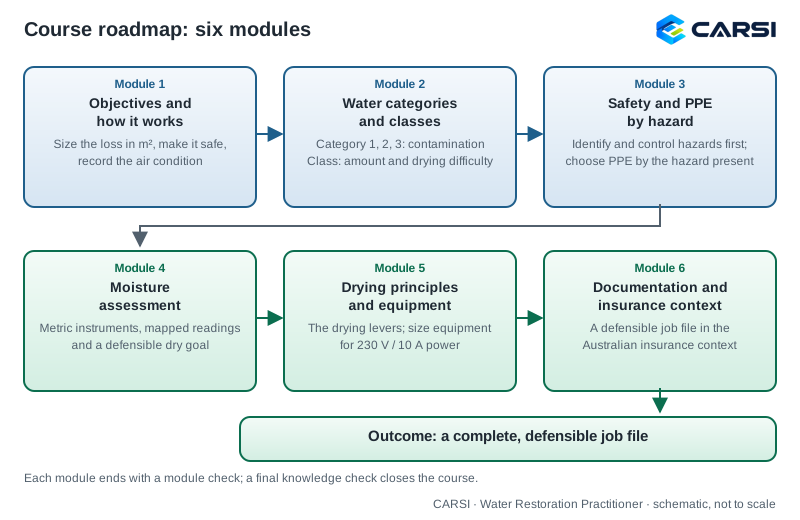
The roadmap shows how the six modules build on one another, from first principles to a complete, defensible job file.
Do it in metric
Size the Brisbane loss before you quote anything. The kitchen is 4.2 m × 3.0 m = 12.6 m². Water has also tracked into a hallway 3.5 m × 1.0 m = 3.5 m². The affected floor area is therefore about 12.6 + 3.5 = 16.1 m². You record the ambient air on arrival at 24 °C and 70 %RH. These two numbers — affected area in m² and the starting air condition — are the first entries in the job file and the basis of every later decision.
Field download
The First-attendance roadmap card lists the order of the first hour on site: make safe, size the loss in m², record the air condition, identify the water, and set expectations with the customer. Keep it in the van.
Check yourself
The module check asks: what is the first task on arrival; which metric figure sizes the loss; and why you record the starting air condition. Each answer carries a short practitioner “why”.
Takeaway
Restoration starts with sizing and safety, not with machines. Record the affected area in m² and the air condition at the first attendance. Next lesson: how the restoration mindset turns these first numbers into a repeatable process.
Sources for this lesson
- ANSI/IICRC S500:2025 (cited by name only; no text reproduced).
- NSW Government, Voltage optimisation fact sheet. Read 02/11/2026.
- Ausgrid, Electricity Safety: Electrical equipment. Read 02/11/2026.
- WorkSafe ACT, Residual current devices. Read 02/11/2026.
Who it is for
Built for crews who cannot leave site
- Restoration professionals working in water restoration
- Practitioners pursuing the CARSI Water Restoration Practitioner designation
- Australian and New Zealand trade professionals expanding their qualifications
Enrol
Start this course when the roster allows
Complete the course and receive a verifiable digital credential for your portfolio.